Visitor or Resident? Mapping My PLN
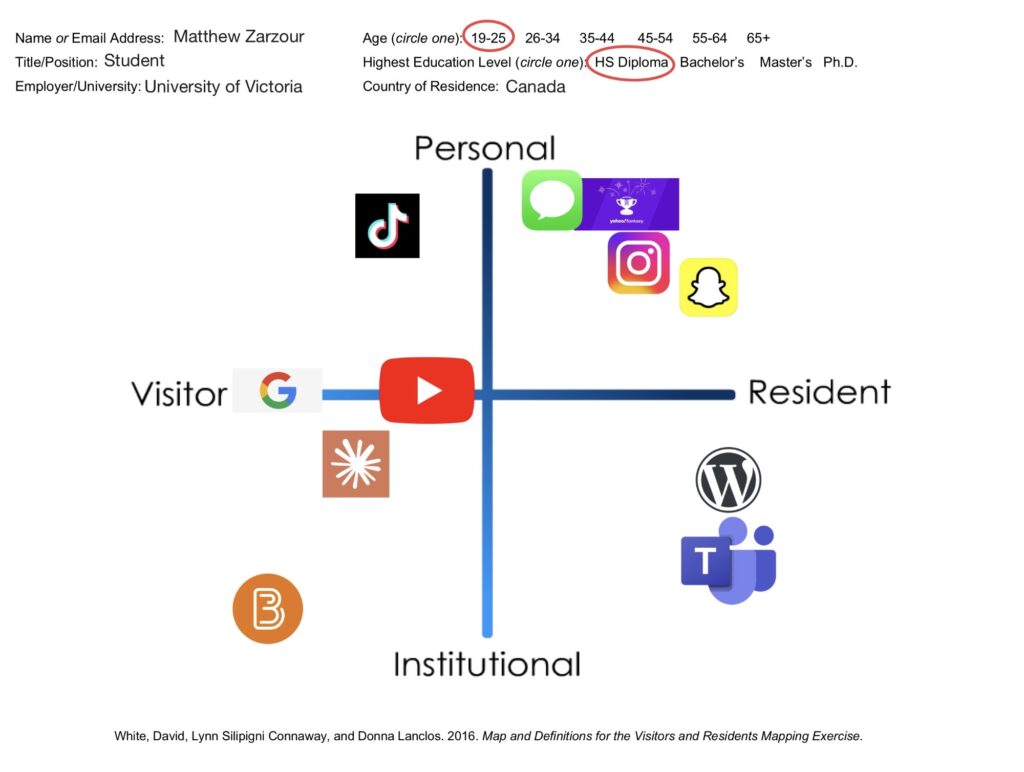
Right now, most of what I learn comes from my UVic professors and The Organic Chemistry Tutor on YouTube. I actually learn a lot from them, but it’s pretty much just me taking in info. They don’t really know anything about me. This actually makes sense when you look at the Visitors and Residents video from David White. Basically, you can be more active on some sites and just kind of lurk on others. For me, I’m more of a resident in my personal stuff, but just a visitor when it comes to professional things. Like with The Organic Chemistry Tutor, he’s got over ten million subscribers, and I’ve learned a ton from him, but he has no clue who I am.
I’m in my fourth year of biology and still trying to figure out if I want to go into optometry or law. Most of the people who could actually help me decide (like people already working in those fields or students ahead of me) are online, and I only would learn through a visitor lens, such as viewing their reddit posts anonymously and not interacting with a post. However, I did have one offline resident learning experience. When I met with my family lawyer friend for coffee to discuss my career goals, it was more of a resident behaviour, due to him knowing me personally, and having a personal conversation about my future. To expand my PLN, I need to have resident interactions online too. For example, I could use LinkedIn to reach out to current lawyers and optometrists and discuss with them why they chose their current career paths, and what they would change.
When I search for my name on Google, the first result is my Elite Prospects hockey page, which I didn’t make, followed by my Instagram. An employer would see that I played hockey, which is not a negative point, but there is nothing relating to biology, optometry or law. Robles-Carrillo (2024) described digital identity as all the information about us that exists online, both the things we create and the stuff people create about us. My Elite Prospects page is the kind that people create about me. That’s also where I think the Visitors and Residents idea falls a bit short, since it only looks at how I use the web, not what other people post about me.
Privacy is kind of a two-edged sword. Hartzog and Selinger (2014) stated that once your info is out there, you can’t fully erase it, but you can make it more obscure (harder to find). For my Instagram, since it’s set to private, they would have to either follow me to view the posts. This makes it obscure for future employers and strangers, but people that follow me can still see them. The other side to this argument is complete obscurity. I think if you can find nothing on any platform, like if you are a complete ghost, that can signal a red flag, like someone may think you have done something wrong and have scrubbed any digital footprint you had.
Has anyone ever contacted a stranger in their desired career field online? Did you follow through with it? How did you communicate?
References
Hartzog, W., & Selinger, E. (2014, May 20). Google can’t forget you, but it should make you hard to find. Stanford Center for Internet and Society. https://cyberlaw.stanford.edu/publications/google-cant-forget-you-it-should-make-you-hard-find/
Robles-Carrillo, M. (2024). Digital identity: An approach to its nature, concept, and functionalities. International Journal of Law and Information Technology, 32, Article eaae019. https://doi.org/10.1093/ijlit/eaae019
The Organic Chemistry Tutor. (n.d.). The Organic Chemistry Tutor [YouTube channel]. https://www.youtube.com/channel/UCEWpbFLzoYGPfuWUMFPSaoA
White, D. (2014). Visitors and residents [Video]. YouTube. https://www.youtube.com/watch?v=sPOG3iThmRI