Community Contribution #4: Affordances of Platforms that Support PLNs.
Technology has let me learn from people that I would have never met had we not had the internet. The catch is there is little to no engagement with these people, since I usually just read what they’ve said (either through Reddit, YouTube or Instagram). I think this takes away a crucial part of learning, which is the social interaction, and the information is not necessarily applicable to everyone.
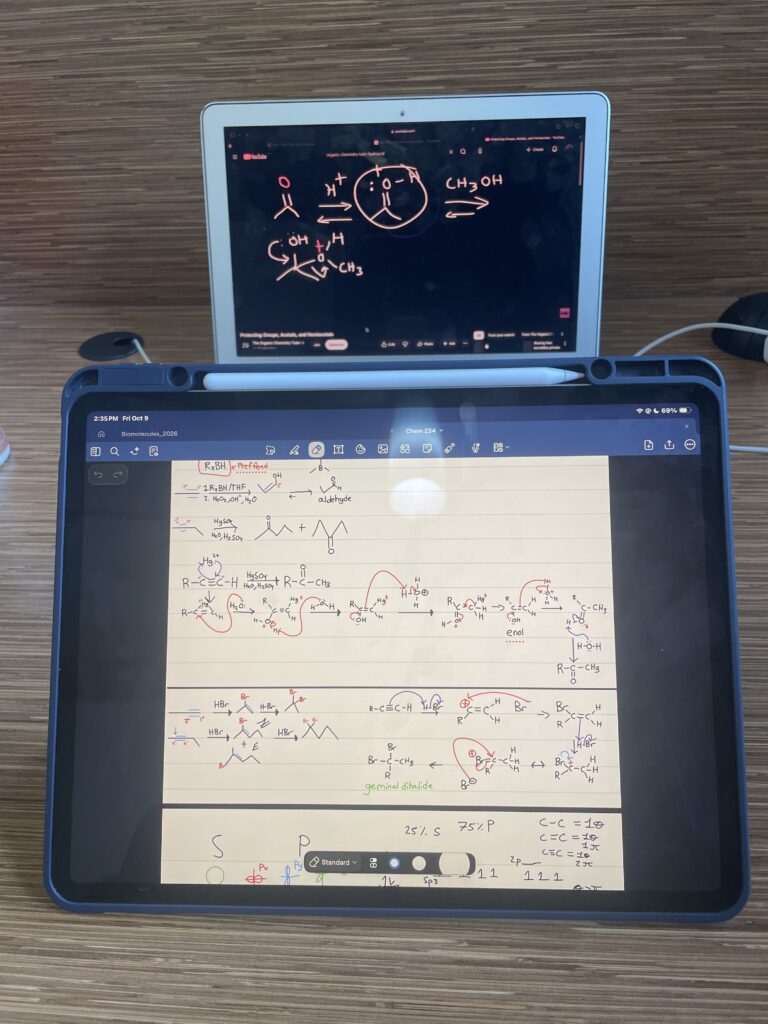
For example, the Organic Chemistry Tutor is very helpful for learning the general information of organic chemistry. He explains the full mechanism, gives lots of examples, and covers common questions. This is about 90% of what I need for learning the content. However, since he is a content creator with a large audience, I cannot ask him a question if it’s something he doesn’t answer within the video. This connects to what Bucher and Helmond (2018) talk about. They say that an affordance is more than just a feature. It’s about what a platform lets you do or makes harder for you. YouTube lets one person reach a ton of people, but it’s actually pretty hard for someone watching to really talk to the creator. That is where asking my professor during office hours helps me understand my own mistakes or flaws in logic and fix what I haven’t learned. This also connects to Norman’s (2014) ideas about mental models. Sometimes, the way we understand something is incomplete or wrong, and talking to my professor helps me figure out where my thinking went wrong.
I grabbed coffee with a family friend who’s a lawyer, and he asked me why I first wanted to go into optometry and what made me start thinking about law instead. It was way different than just reading stuff online or scrolling through Reddit, because he could actually ask me questions and understand where I was coming from. LinkedIn is kind of in the middle, since you can connect with people and ask for advice, but it’s not the same as talking to someone in person. Digital stuff is good for facts, but when it comes to figuring out what you actually want to do, real conversations help a lot more.
Have you found face-to-face conversations more helpful than digital resources when making important career decisions?
References
Bucher, T., & Helmond, A. (2018). The affordances of social media platforms. In J. Burgess, A. Marwick, & T. Poell (Eds.), The SAGE handbook of social media (pp. 233–253). SAGE.
Norman, D. A. (2014). Some observations on mental models. In D. Gentner & A. L. Stevens (Eds.), Mental models (pp. 7–14). Psychology Press.