How do personal versus professional approaches to digital identity affect social media use?
Digital identity is the way a person presents themselves and how they are perceived online. Identity online can be shown multiple ways, through photos, comments, likes, profile photos, and just general social media accounts. Your digital identity can be completely different than your person or exactly the same. I have a cousin who is pretty big on youtube, and she’s completely different from her lifestyle vlogs she posts. Yet one of my good friends is decently popular on tiktok (170k followers) and he is exactly how he posts himself, no filter at all. No matter which way you decide to post, it’s still a curated decision to influence how people view us in both a professional and personal sense.
For me, back in 2023-2024, I streamed a lot of Rainbow Six Siege (a popular FPS game) in which you play 5v5. There are competitive tournaments, and the viewership was massive due to a rise in the streamer Jynxzi. Since I had no facecam and my username was different than my personal name, the people I played with and people that watched did not know who I was personally, so there was less of a need to play a performance and carefully make sure everything I posted was perfect because it wasn’t for my own personal identity. However, on my personal Instagram, I only have 2 posts with my girlfriend and I don’t really like many posts unless it’s of people I know. I want my profile to never interfere with future employment, further education, etc.
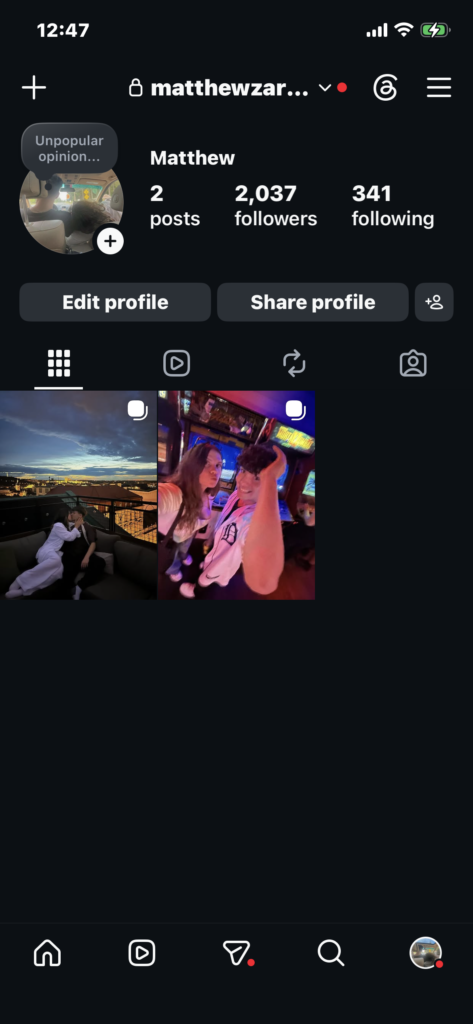
My Instagram profile: the lock next to my name indicates it’s private.
Keeping that Siege identity separate from my intentionally insignificant Instagram shows what “Digital Professional Identity” (DPI) means in practice. Jawed, Mahboob, and Yasmeen (2019) describe DPI as the professional self image formed by online interactions, and they point out that social media is important in shaping how future professionals are seen. They mention how students do not realize how their personal and professional identities can overlap online. This is something that I thankfully learned when I was younger. I have never been interested in being known in public for social media. I’ve been best friends with Finley since grade 3, so anything cringey that I’ve posted as a middle schooler I have been sent repeatedly, so that only reinforces that you should only post something you’re okay with the whole world seeing and you yourself will be okay seeing 8-10 years later. As I prepare for optometry school, I see my Instagram as more of a tool and something to only share what you are okay with future employers, friends, loved ones seeing. While my Instagram is private, I am still aware that once something is posted or liked, its receipt is never fully gone.
In an ideal world, personal and professional digital identities would be completely separate. However, your personal identity will always affect your profession. That being said, would you say that because of the filter you need to use on your personal social media in order to make sure it doesn’t affect your professional life, does it still feel personal? If you only use it with the thought of your professional life is it still personal? Is it even possible to have a clean split between professional and personal Digital identity anymore?
References:
Jawed, S., Mahboob, U., & Yasmeen, R. (2019). Digital professional identity: Dear Internet! Who am I? Education for Health, 32(1), 33–35. https://doi.org/10.4103/efh.EfH_232_17