Visitor or Resident? Mapping My PLN
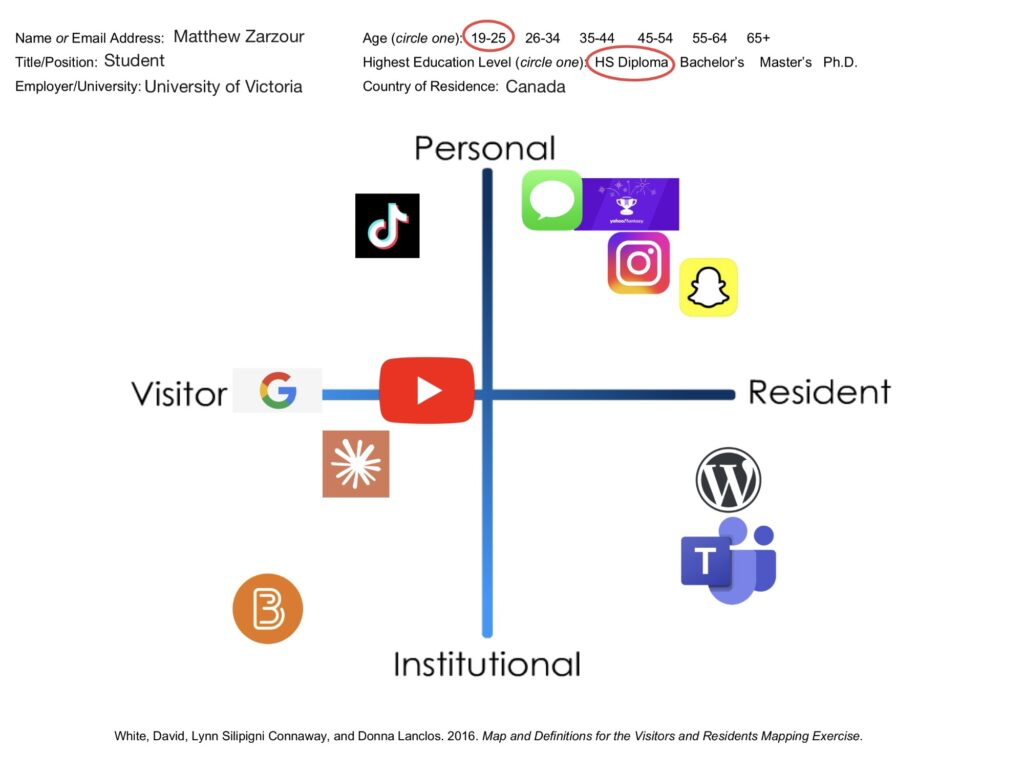
Right now, most of what I learn comes from my UVic professors and watching The Organic Chemistry Tutor on YouTube. I get a lot out of it, but I just take in the info and don’t really talk to the people teaching it. This connects to the Visitors and Residents idea from David White. Being a Visitor means you use the internet to look stuff up, and being a Resident means you interact with people and have a presence online (White, 2014). It’s not like you’re stuck as one or the other forever, though. You can be both, and even use the same site in different ways.
White and Le Cornu (2017) also talk about the personal and institutional reasons people use the internet. For me, I see myself as more of a Resident in my personal life but more of a Visitor when it comes to professional learning. For example, I watch YouTube videos to learn organic chemistry and biology, but The Organic Chemistry Tutor doesn’t know who I am. I also read Reddit posts about careers like optometry and law without commenting or interacting with anyone because I don’t have an account. It’s useful for getting information, but I’m not connecting with people who could help me figure out what career I want to pursue.
I’m in my fourth year of biology at UVic and still can’t decide if I want to go into optometry or law. I got coffee with a family friend who’s a lawyer, and it was way more helpful than reading stuff online. I got to ask real questions and hear what it’s actually like, along with advice that was specific to me. That made me realize I should probably try contacting more people, like lawyers or optometrists, maybe through LinkedIn or even email, and ask them about their jobs. Royal, a classmate who commented on my original CC #2 post, talked about emailing professors and research labs at UVic, which is the same idea. Instead of just lurking and reading what people post, I could talk to them and maybe get some real advice.
When I search my name on Google, my Elite Prospects page, which is a hockey stats website, appears even though I didn’t create it. Robles-Carrillo (2024) explains that digital identity includes information about us that we create ourselves and information created by other people. This made me realize that we don’t have complete control over how we appear online, since other people can post information about us too. Sienna, another classmate who commented on my original CC #2 post, made me think more about how much control we have over our online identities. I think this is a limitation of the Visitors and Residents framework, since it doesn’t fully account for information about us that other people put online.
Looking back at my original post and my Visitors and Residents map (Figure 1), it’s pretty clear I use the internet differently depending on what I’m doing. Some things I look up and move on, and others I get involved in. I want to try being more active in my professional PLN from now on, like messaging people instead of just reading their posts.
Has anyone reached out to someone in their desired career field through LinkedIn or email? Did it lead to a useful conversation or connection?
References
Hartzog, W., & Selinger, E. (2014, May 20). Google can’t forget you, but it should make you hard to find. Stanford Center for Internet and Society. https://cyberlaw.stanford.edu/publications/google-cant-forget-you-it-should-make-you-hard-find/
Robles-Carrillo, M. (2024). Digital identity: An approach to its nature, concept, and functionalities. International Journal of Law and Information Technology, 32, Article eaae019. https://doi.org/10.1093/ijlit/eaae019
The Organic Chemistry Tutor. (n.d.). The Organic Chemistry Tutor [YouTube channel]. https://www.youtube.com/channel/UCEWpbFLzoYGPfuWUMFPSaoA
White, D. (2014). Visitors and residents [Video]. YouTube. https://www.youtube.com/watch?v=sPOG3iThmRI